What Is an Eleanor Mustang? The Complete History & Legend
Updated: Aug 7

Ask any car enthusiast to name the most famous movie car ever built, and you'll hear three names fight for the top spot: the Batmobile, the DeLorean, and one very specific Mustang. Eleanor was never a factory model. Ford never sold her on a dealer lot. She was never a trim package or an option code. And yet she's arguably more recognizable today than half the Mustangs Ford actually built.
An Eleanor Mustang is a custom movie car created for the Gone in 60 Seconds film franchise, not a car Ford ever manufactured. She first appeared in the independent 1974 original, then returned in the 2000 remake as a 1967 Mustang Fastback styled to resemble a Shelby GT500. Today, "Eleanor Mustang" refers to any tribute or officially licensed build made to recreate that look.
This exact Eleanor goes to auction on August 22, 2026, at Kool Deadwood Nites
Officially licensed, 1-of-1, dyno-verified at 1009 horsepower, with full provenance documentation. View the full auction details.
The Movie That Created Eleanor
The 1974 Original, Gone in 60 Seconds
Eleanor's story starts decades before the version most people picture today. In 1974, independent filmmaker H.B. "Toby" Halicki wrote, directed, produced, and starred in Gone in 60 Seconds on a budget of roughly $150,000, most of it his own money.
The plot was simple. A crew of car thieves has to steal 48 cars in one day. Each car gets a woman's codename to keep police guessing over the radio. The last car on the list, and the hardest one to catch, is a bright yellow 1973 Ford Mustang Mach 1 named Eleanor. In reality, the car was a modified 1971 Mustang Sportsroof, restyled with 1973-style trim to match the script.
What made the film memorable wasn't the budget. It was the commitment. Halicki did most of his own stunt driving, and the movie built its reputation on one of the longest continuous car chases ever filmed. This Eleanor wasn't flashy. No supercharger, no wide-body kit, close to mechanically stock. She was built to survive abuse, not to look aggressive parked in a garage. For a generation raised on VHS copies of the film, that was enough to start a legend.
The 2000 Remake That Made Her a Legend
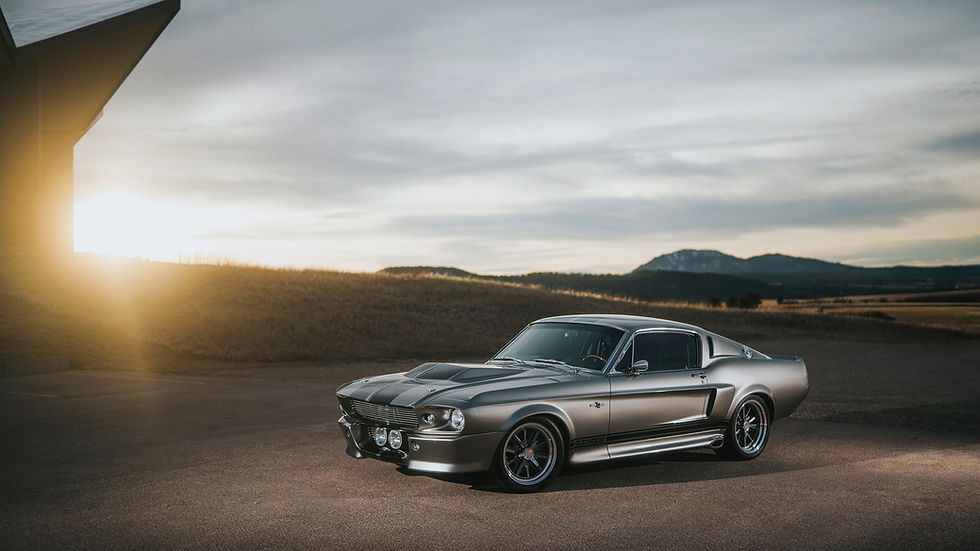
Ask most people today to picture an Eleanor Mustang, and almost nobody describes a yellow 1973 fastback. They describe a Pepper Gray 1967 Mustang with black Le Mans stripes, a wide hood scoop, and a stance that looks fast standing still. That's the 2000 remake talking, and it's the reason Eleanor became a global icon instead of a regional cult favorite.
Produced by Jerry Bruckheimer for Disney and directed by Dominic Sena, the remake starred Nicolas Cage as retired car thief Randall "Memphis" Raines, alongside Angelina Jolie, Giovanni Ribisi, and Robert Duvall. The plot kept Halicki's original setup: a crew has to steal 50 cars in one night, and Eleanor, now reimagined as a Shelby GT500-styled 1967 fastback, is the fiftieth and final car, the one Raines has never managed to steal.
Designer Steve Stanford drew the look, and Cinema Vehicle Services built it with help from coachbuilder Chip Foose. None of the movie cars were real Shelbys. The team built 11 cars from standard 1967 Mustang Fastbacks, then added custom body kits to create the GT500 look. Only three were fully functional "hero" cars used for close-up shots. That gray-and-black design became so iconic that it retroactively became the default image people associate with the name Eleanor, even though it didn't exist until 26 years after the character's first appearance.
Why She's Called "Eleanor"
The Codename Behind the Name
The name has nothing to do with paint or styling. It comes straight from the plot. In both films, the thieves assign every target car a woman's name to keep their radio chatter discreet during the heists. Eleanor is always the last name on the list, and always the hardest car to catch.
In the 1974 film, she's the yellow Mustang that gives Halicki's character the most trouble. In the 2000 remake, she's the Shelby GT500 that Memphis Raines calls the one that got away. Either way, the name marks the car every thief wants most and struggles hardest to get.
What Makes a Mustang an "Eleanor"
The Signature Body Styling Cues
An Eleanor build starts with a 1967 or 1968 Mustang Fastback. From there, a specific set of changes gives the car its identity:
Body Part | What Changes |
Front fascia | Custom nose panel replaces the stock bumper and valance |
Hood | Bulging hood with a functional or aesthetic scoop |
Side skirts | Cutouts for side-exit exhaust pipes |
Fenders | Wider, flared panels for a muscular stance |
Rear decklid | Integrated spoiler, often called a "whale tail" |
Quarter panels | Side scoops near the rear pillars |
Lighting | Center-mounted fog lights and updated taillights |
The "Go-Baby-Go" shifter knob is another signature touch. In the film, pressing it triggers a fake nitrous boost. Most tribute builds include a version of it as a nod to the movie. You can see how these cues come together on this specific build on our bodywork page.
The Pepper Gray and Black Stripe Look
Color matters as much as the body kit. The correct look uses Dupont Pepper Gray Metallic paint with black Rally stripes running down the hood, roof, and trunk, the exact combination from the 2000 film. Builds using a different color, like silver or charcoal, get close, but purists consider Pepper Gray with black stripes the only true match to the movie car.

Is Eleanor a Real Shelby GT500?
No. Eleanor has never been an actual Shelby GT500, in either film. Every movie car, and every build sold today, starts life as a standard 1967 or 1968 Mustang Fastback. Builders then add a Shelby-style body kit to recreate the look. A real numbers-matching Shelby GT500 is a factory-built car with its own VIN history. An Eleanor is a Mustang dressed to look like one.
Licensed Build vs Tribute Car
This is where things get legally complicated, and it's worth understanding before spending six figures on a build.
In 2002, a Shelby-affiliated company registered a trademark tied to the Eleanor Mustang and began licensing replica production to outside builders. Denice Shakarian Halicki, H.B. Halicki's widow, sued in 2004, arguing that she held the rights to the Eleanor character as it appeared in the films, not Shelby. In 2008, the Ninth Circuit Court of Appeals ruled in her favor, a decision later cited in unrelated cases involving other iconic movie vehicles, including the Batmobile.
Halicki formed Eleanor Licensing LLC and began issuing official licenses to specific builders. In October 2023, a federal court reaffirmed her ownership of the copyrights and trademarks tied to the Eleanor character across the franchise.
That's not the end of the story. On May 27, 2025, the Ninth Circuit reversed course in a separate case, Carroll Shelby Licensing, Inc. v. Halicki, ruling that Eleanor is not a copyrightable character under the legal standard used for protecting fictional characters like the Batmobile. The U.S. Supreme Court declined to hear an appeal in November 2025, so that ruling now stands.
Here's what this means for buyers today:
Copyright protection on the car's design and styling is gone. Builders can legally recreate the look without infringing copyright.
Trademark rights to the name "Eleanor" and "Gone in 60 Seconds" branding still belong to Halicki's companies. Official certification, VIN plates, and emblems still come only from licensed builders.
A licensed build carries documented paperwork tying it to the official Eleanor brand, issued by Eleanor Licensing LLC or Gone in 60 Seconds LLC.
A tribute build replicates the look without that paperwork, and now sits on firmer legal ground than it did before 2025.
For buyers focused on resale value, licensing paperwork still matters most. You can review the full documentation behind this build on our Provenance and Authenticity page.

How Eleanor Compares to Other Iconic Movie Cars
Eleanor isn't the only vehicle to outgrow the film it appeared in, but she sits in a fairly unique spot. The Batmobile and the DeLorean both benefit from an ongoing franchise with constant merchandising support behind them. Steve McQueen's Bullitt Mustang became iconic almost entirely through one legendary chase scene rather than a built-up story role, and Ford later built factory tribute editions of its own.
Eleanor sits between those two. Like the Batmobile, she has a rights holder who has actively protected her image for decades. Like the Bullitt Mustang, her legend rests on real stunt driving instead of CGI. What sets her apart is that she was never a factory car with an aftermarket legend attached. She was built from the ground up to be a character, which is exactly why the licensing question has been fought over for almost two decades.
This Licensed Eleanor, Built for the Auction Block
If you want to see what documented, modern Eleanor provenance actually looks like instead of just reading about it, this build is one of the clearest examples on the market. It's an officially licensed 1-of-1.
Under the hood sits a custom Prestige Motorsports 427 Ford Power Adder engine with a Vortech V7 supercharger, dyno-verified at 1009 peak horsepower, roughly double what most Eleanor tribute builds produce. Every component is serialized and documented back to the original build sheets. You can see the full technical breakdown, including the dyno records, on the engine page.
This is the direction the entire Eleanor market has moved: from a single movie prop, to a legally contested trademark, to a documented category of high-performance collector car. This build goes to auction on August 22, 2026, at Kool Deadwood Nites, with a backup sale planned at Mecum Auctions in Kissimmee in January 2027 if it doesn't sell in August.
Frequently Asked Questions
How much does an Eleanor Mustang cost?
Prices vary widely based on build quality and documentation:
Officially licensed tribute editions: $180,000 to $300,000, with some high-end builds reaching $500,000 or more
Unlicensed tribute builds: Can start lower, but quality and resale value vary significantly
Screen-used movie cars: Have sold for $775,000 to over $1 million at auction
Engine choice, build quality, and documentation all affect where a specific car lands in that range.
What engine does an Eleanor Mustang have?
There's no single factory engine, since Eleanor was never a factory car. Builders typically choose from a few proven options:
428 Cobra Jet V8: Closest match to the original 2000 movie cars
427 big block V8: Chosen for heavy torque and a classic muscle car feel
Supercharged 5.0L Coyote V8: A modern option for restomod-style builds
351 Windsor V8: A lighter small-block, common on entry-level builds
This specific build runs a supercharged 427 Power Adder V8 dyno-verified at 1009 horsepower. Full specs are on the engine page.
Can you buy an Eleanor Mustang today?
Yes. Licensed builders still produce official Eleanor tributes, and completed builds regularly appear at major auctions like Barrett-Jackson and Mecum. A licensed 1-of-1 example, dyno-verified at 1009 horsepower, is scheduled to cross the block on August 22, 2026, at Kool Deadwood Nites. Check the auction listing for full details.


Comments